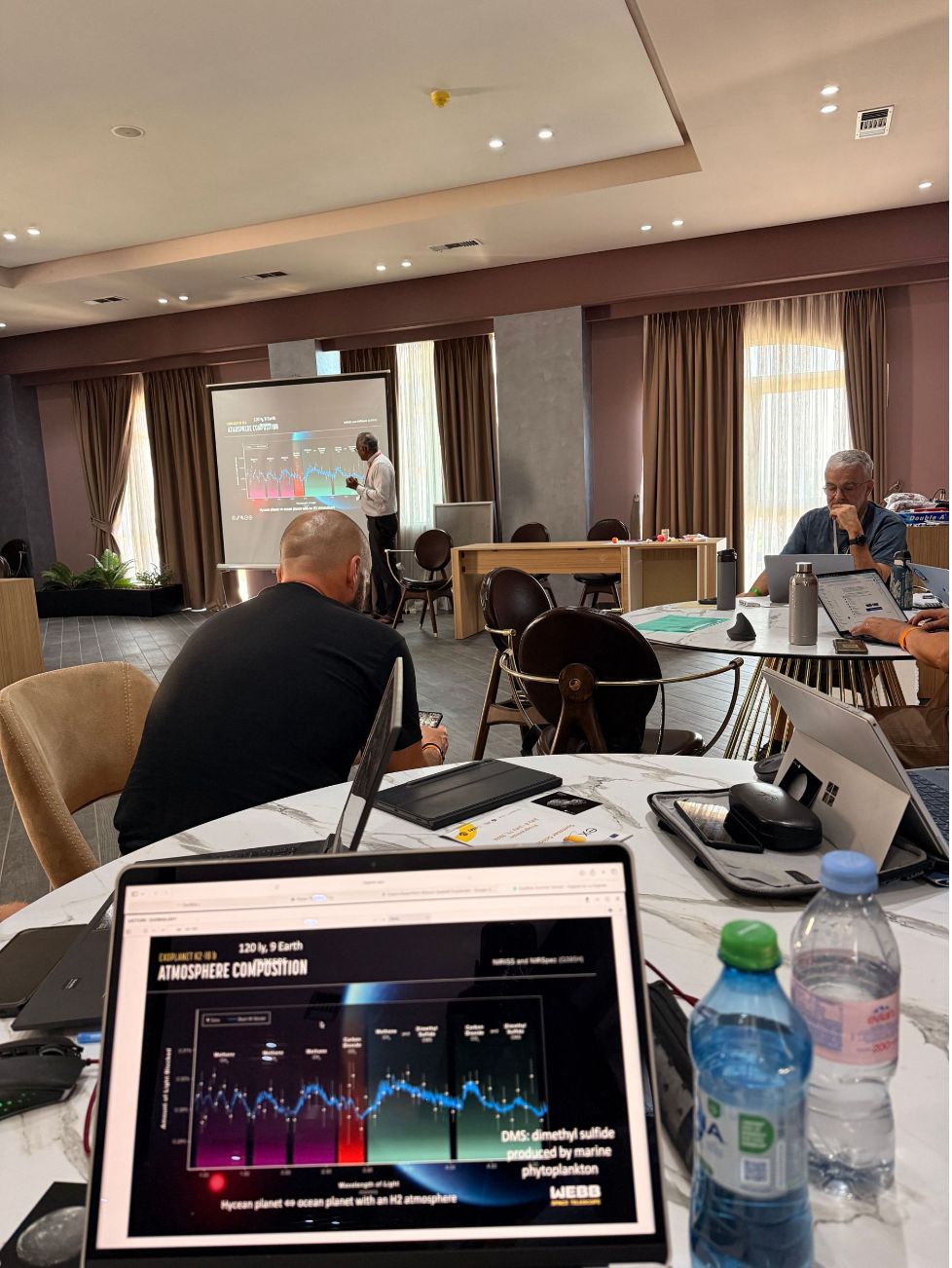
“Onisifor Ghibu” National College in Oradea hosted an event dedicated to the Exo4Edu – Exoplanets for Education project. The presentation was delivered by prof. Andrada Cristea, a mathematics teacher who also teaches astronomy classes. The project website was presented and, above all, the activities that can be carried out directly in the classroom.
The project brings together four partner countries: Romania, Portugal, France and Albania. From 6 to 11 July 2026, Exo4Edu organised its Summer School in the city of Durrës, Albania. Teachers from the four countries took part in a week of hands-on training on exoplanets and the search for life in the Universe. Prof. Andrada Cristea attended this summer school and brought the experience she gained back to her school community.
The Exo4Edu platform offers an interdisciplinary learning experience, with access to scientific knowledge and real data. It includes 3D data visualisation, processing tools and related tutorials. The project aims to support teachers in guiding students through authentic research experiences. It also offers them professional development opportunities for teaching in this dynamic field.
What students and teachers will find on the website:
- Questions about exoplanets. Students start from simple curiosities, such as Do exoplanets look like Earth?, Is there life on exoplanets? or Who are the exoplanet hunters? From there, they move on to fundamental scientific concepts, such as the classification, naming and location of planets.
- Courses. They cover the definitions and properties of exoplanets, detection methods, the instruments used, exobiology (life in the Universe) and self-assessments. They can be followed individually by students or can serve as the basis for teacher-led learning units.
- Database of known exoplanets. It presents the parameters of all known exoplanets. The data is extracted daily from the Extrasolar Planets Encyclopaedia, a worldwide reference for researchers, which collects the properties of exoplanetary systems from international research journals. Students can extract from it the numerical values needed for physics and mathematics problems.
- Tools for exoplanet researchers. Digital tools for analysing light curves and planetary transits.
- Catalogue. A section organised for the systematic identification and exploration of exoplanets.
- Exo3D. A 3D viewer that allows exoplanetary systems to be explored in three dimensions, directly from the browser.
Classroom learning activities
Each activity on the platform includes a detailed lesson plan and all the resources needed to carry it out in the classroom. One example presented at the event is the 6th-grade activity How long would it take you to reach the exoplanets you have chosen? The worksheet contains exercises on calculating speed and travel time by spacecraft, using directly and inversely proportional quantities. Mathematical calculations thus acquire immediate meaning, because students work with distances to real exoplanets.
Prof. ANDRADA CRISTEA,
“Onisifor Ghibu” National College, Oradea
Image source: Andrada Cristea photo archive